


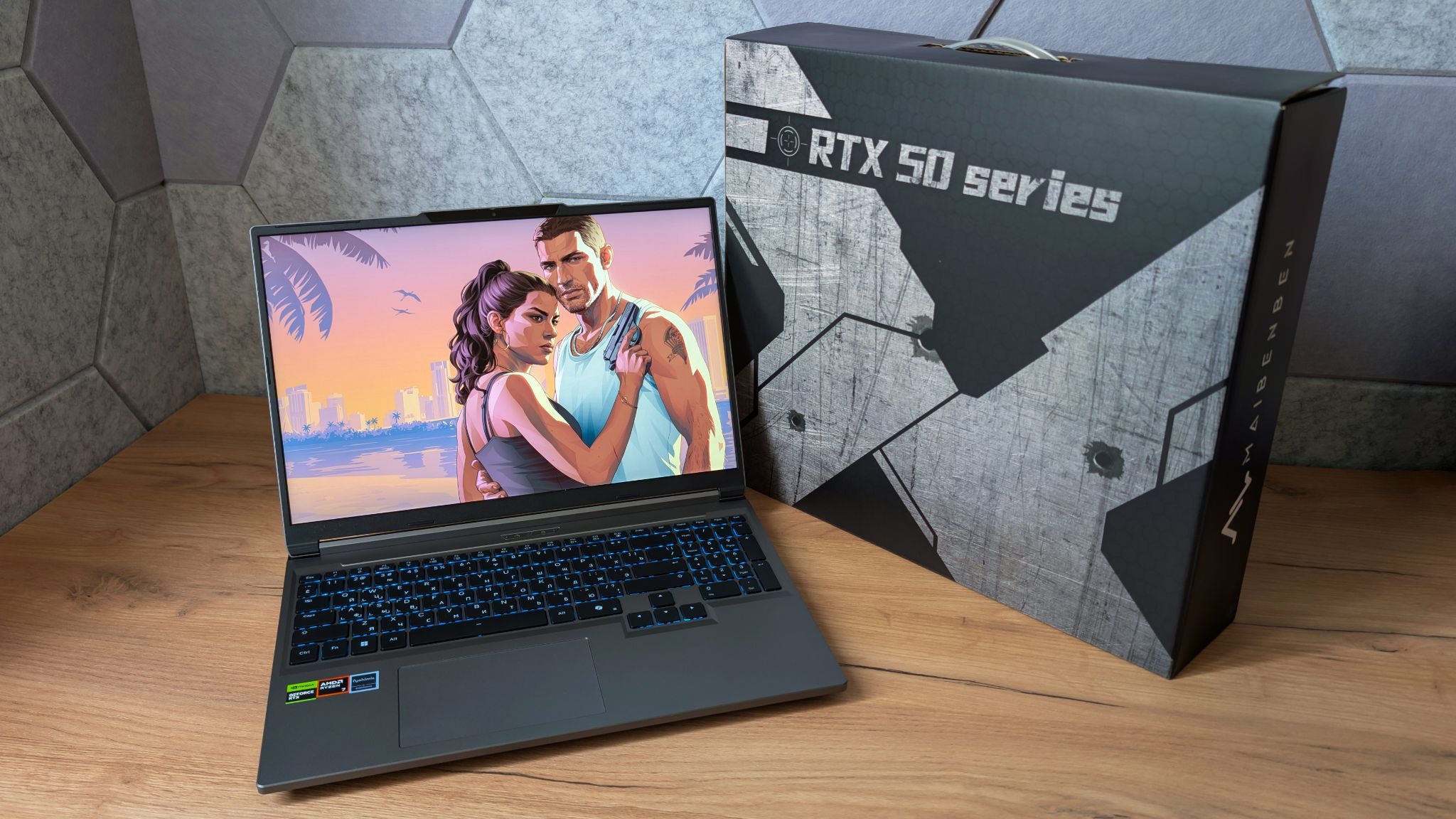
But the gaming notebook segment has long ceased to be a niche for enthusiasts alone. Manufacturers increasingly seek a balance between power, everyday usability, and price, because not everyone needs a top‑tier flagship whose cost rivals a solid desktop PC. Far more appealing are models that let you comfortably run modern titles while remaining a versatile work tool at an affordable price.
Such a device is the MAIBENBEN X16C. At first glance it does not try to surprise with an exotic design or loud slogans. Instead, it offers a current hardware platform based on the AMD Ryzen 7 H 255 processor and the GeForce RTX 5060 Laptop GPU, a screen with a heightened refresh rate, and a typical set of capabilities for its class. Experience shows that the real strengths of such laptops lie not in the spec sheet but in how pleasant they are to use day after day.
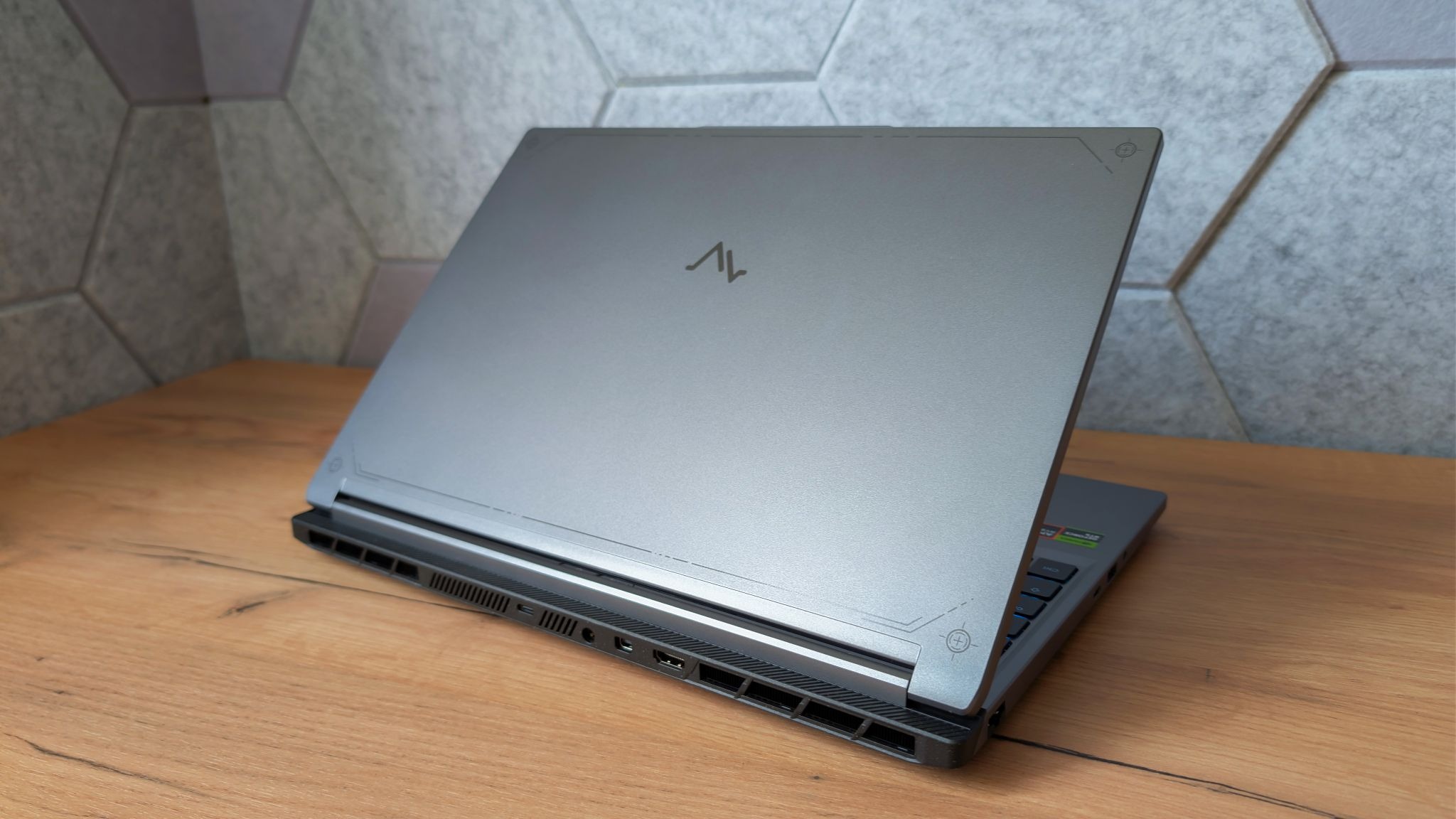
The MAIBENBEN X16C makes a pleasant impression visually. Its chassis is fairly restrained, free of excessive decorative elements. Ignoring the print on the lid, nothing immediately screams “gaming”. Thanks to this neutrality, the laptop fits equally well on a home gaming desk, in an office, or in a lecture hall. Turning off the keyboard backlight makes it almost indistinguishable from a regular workhorse notebook.
Although the design is modest, the chassis cannot be called compact. Inside resides a discrete graphics card, a full‑scale cooling system, and a powerful processor, which together demand a certain amount of internal space. The weight of 2.3 kg sits on the edge of portability – it does not cross that line, so the laptop remains easy to carry around daily.
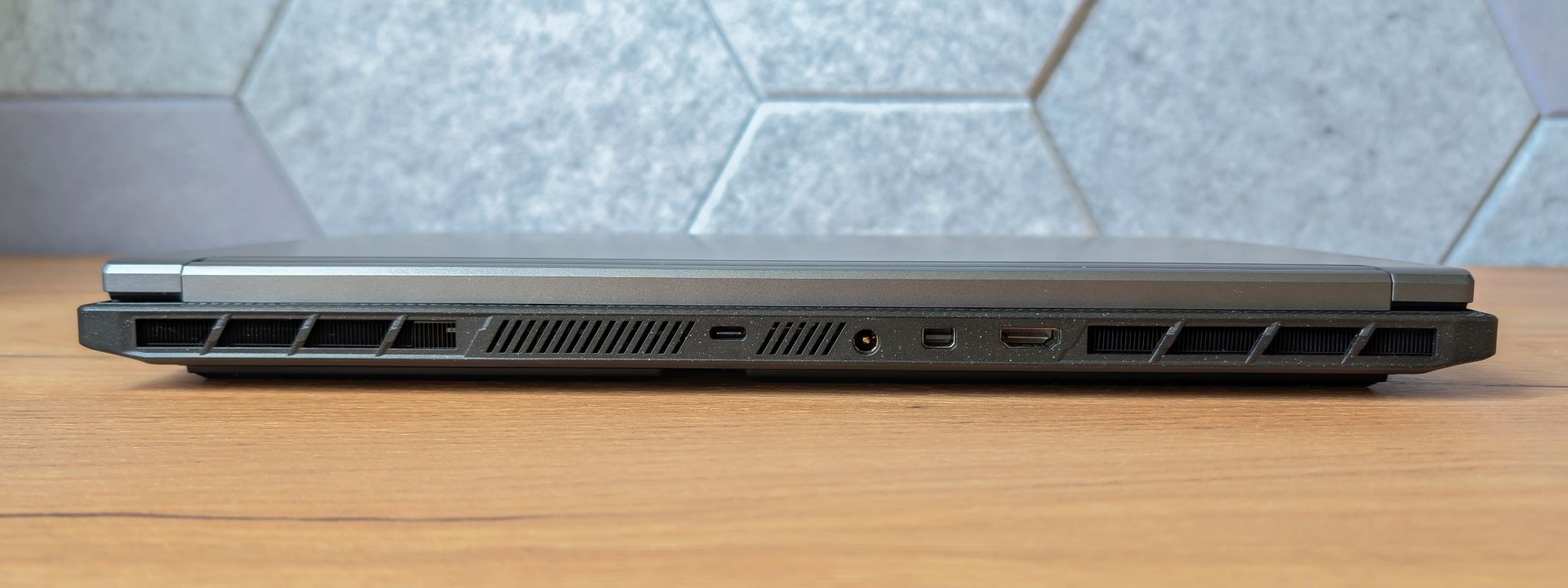
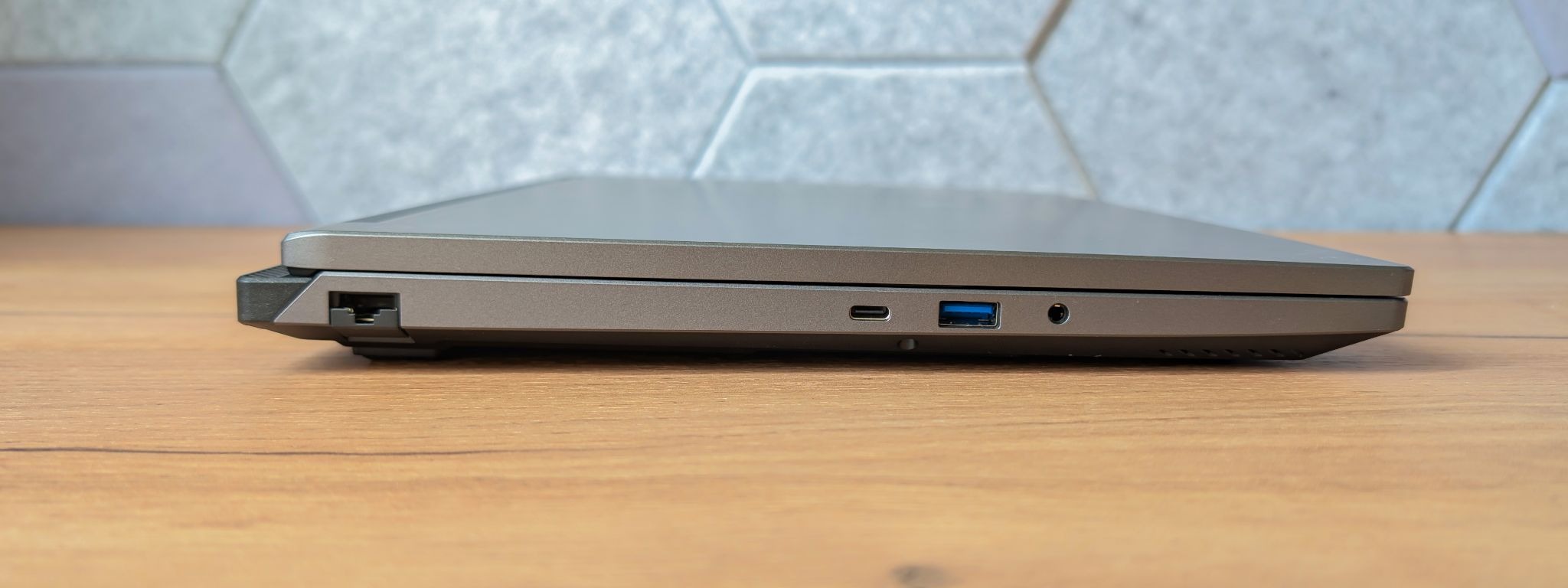
The port selection is quite decent. On the left edge you’ll find an RJ‑45 jack, a USB‑C 3.2 Gen 2 port (supporting Thunderbolt and Power Delivery), a USB‑A 3.2 port, and a combo 3.5 mm audio jack.
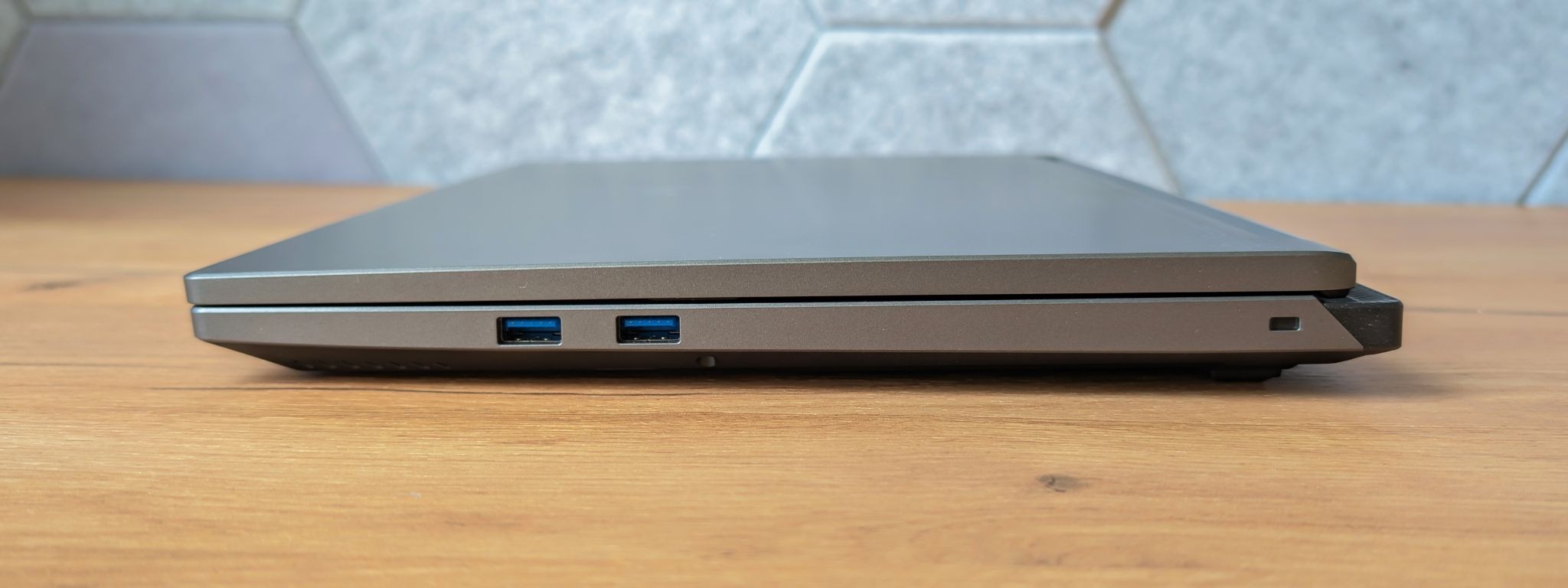
On the right side there are two additional USB‑A 3.2 connectors.
At the rear, besides the power inlet, there is another USB‑C 3.2 Gen 2 port, an HDMI 2.1 connector, and a Mini DisplayPort 1.4.
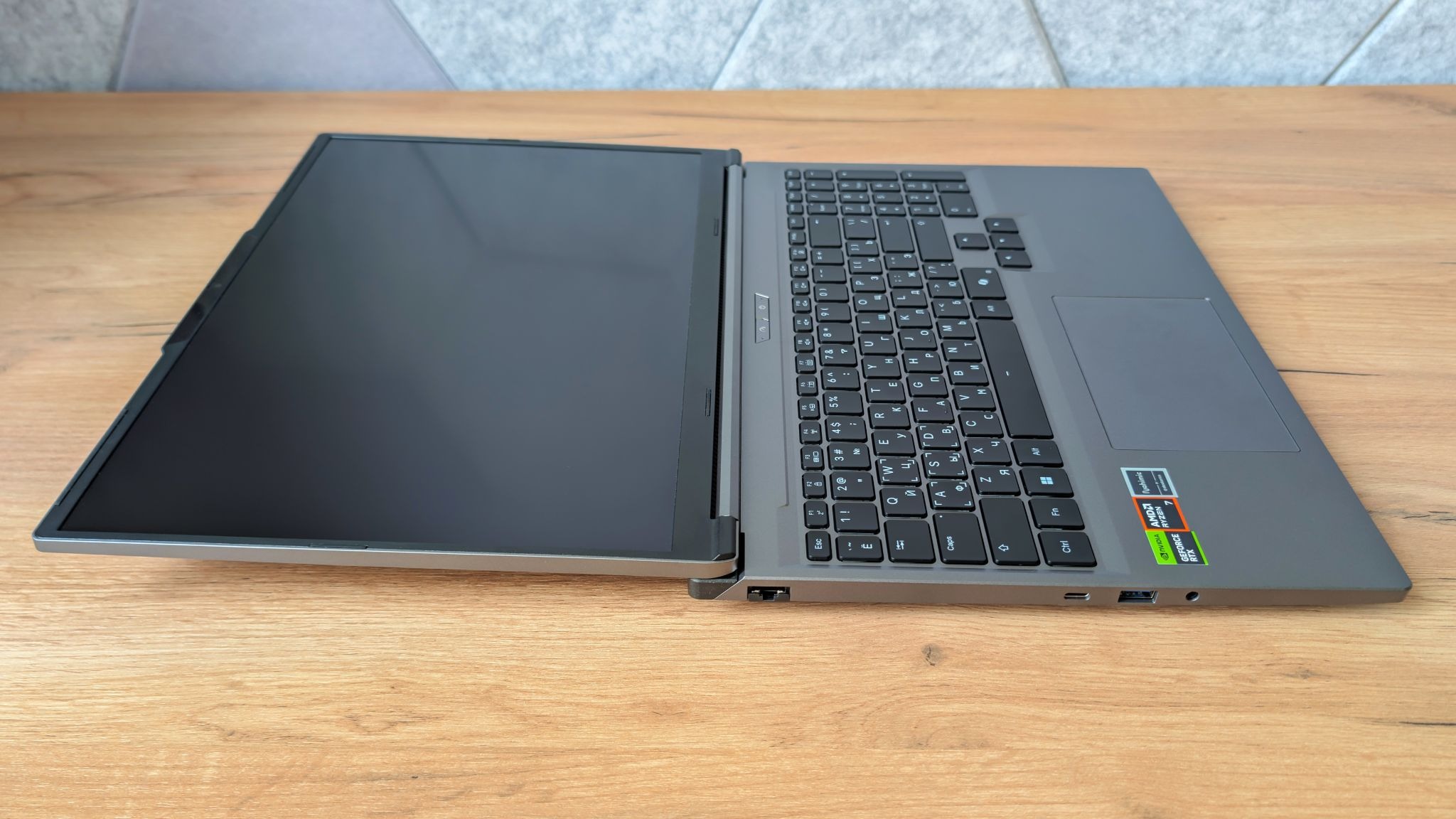
The lid opens smoothly without extra effort, and the hinge is stiff enough to keep the screen steady during work. The base rests firmly on the desk thanks to large rubber feet, preventing the notebook from sliding with every movement.
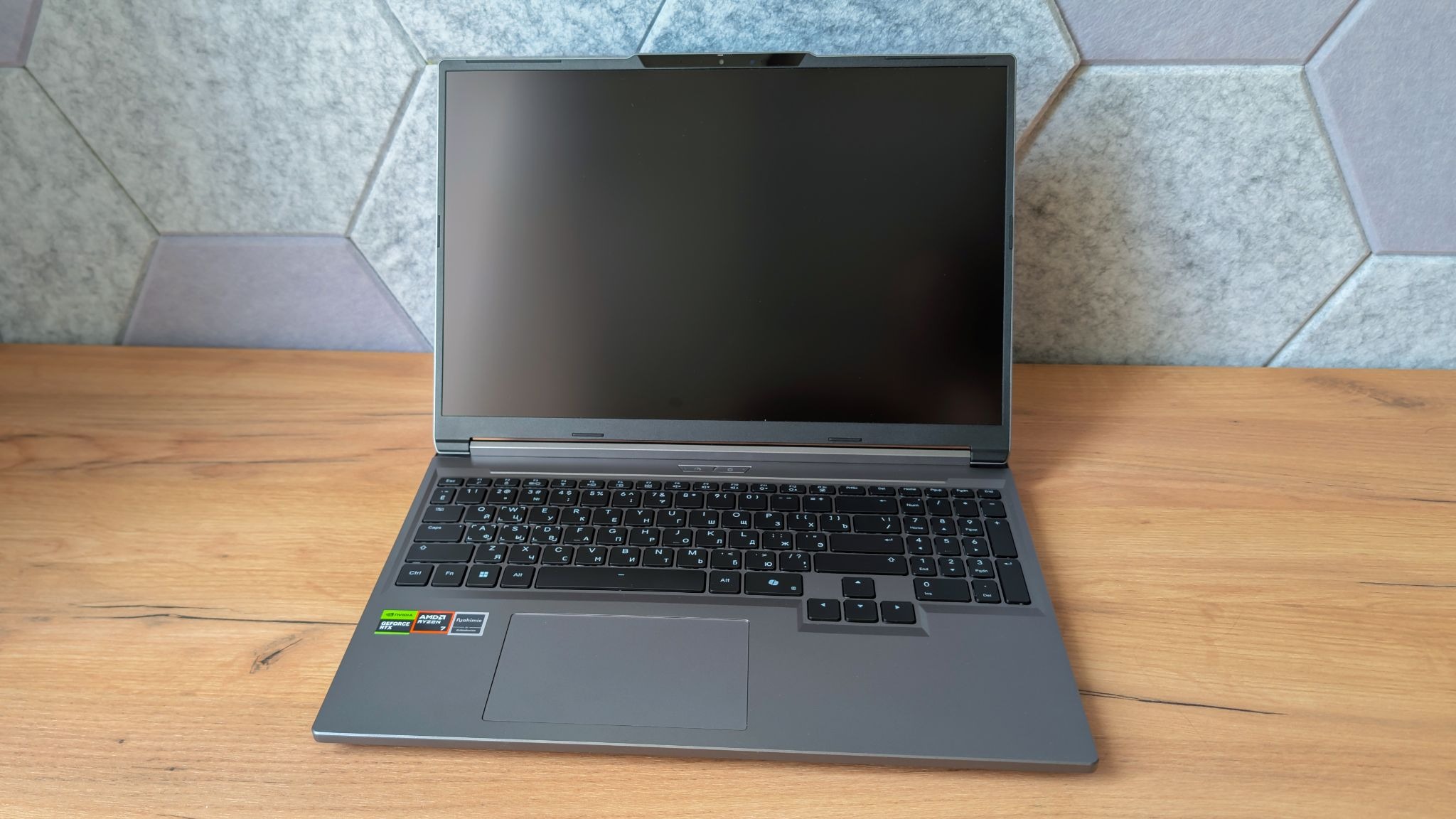
Almost the entire inner surface is occupied by a 16‑inch IPS panel with a resolution of 1920×1200 and a 165 Hz refresh rate. The 16:10 aspect ratio is no longer rare, but after a few days of work you begin to appreciate the added vertical space. This extra room proves useful not only in web browsers or document editors, but also in professional applications where an extra toolbar row reduces the need for scrolling.
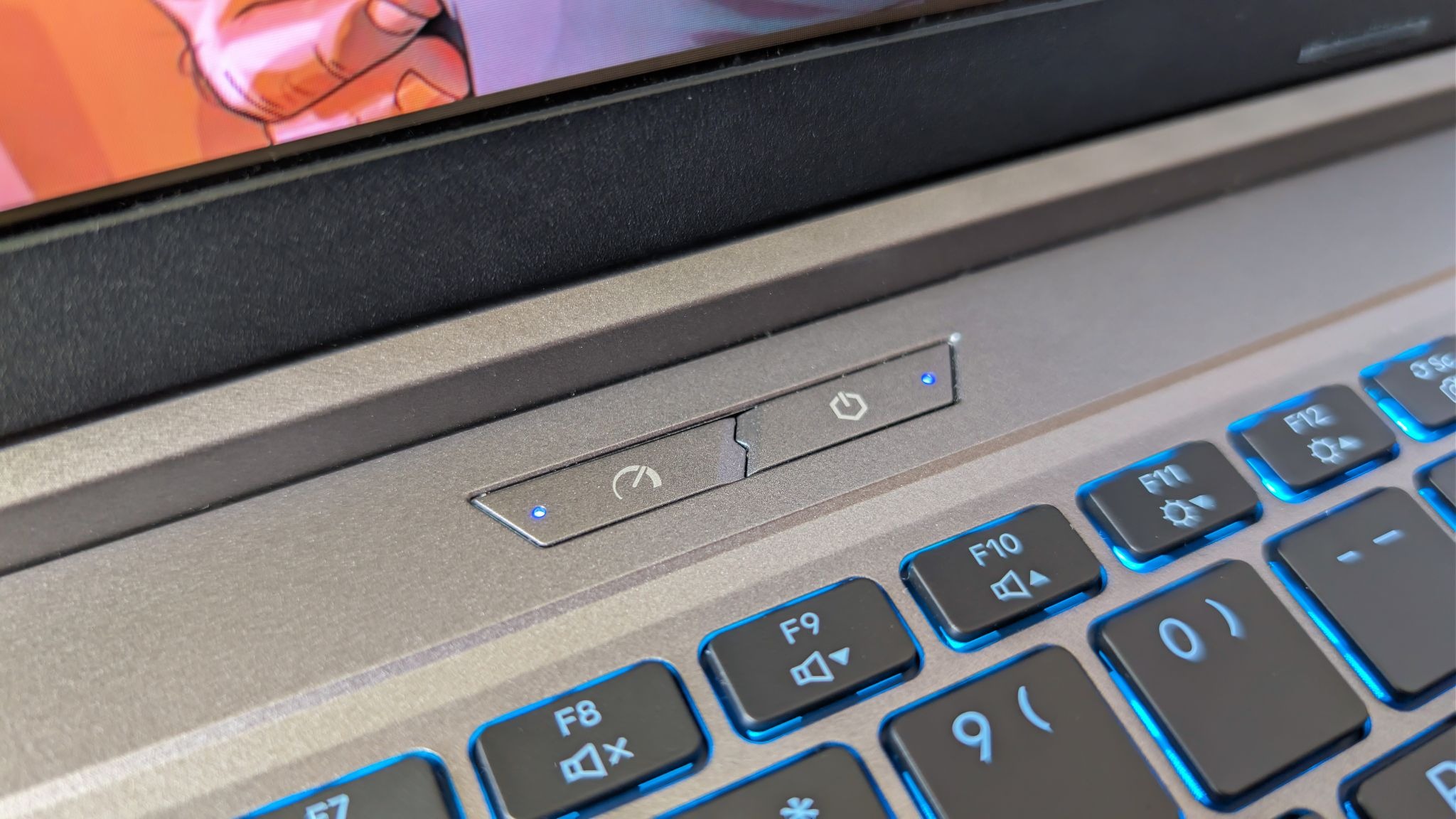
Color reproduction on the display is average. Achieving perfect image fidelity for photo or video work is difficult – hues sometimes lack depth, and accuracy can waver here and there. Still, this is an acceptable trade‑off for the high refresh rate given the price bracket. In games you will not feel deprived of visual quality, which is the main point.

The keyboard is full‑size with a separate numeric block, a boon for those who regularly handle documents or spreadsheets. Key travel is deep and informative, making typing comfortable, while in games the keys do not feel overly soft. Backlight intensity is moderate: it does not glare in daylight and does not blind at night.
The touchpad is spacious, offers good sensitivity, and recognises gestures. Although it is not suited for gaming, it handles everyday tasks perfectly.
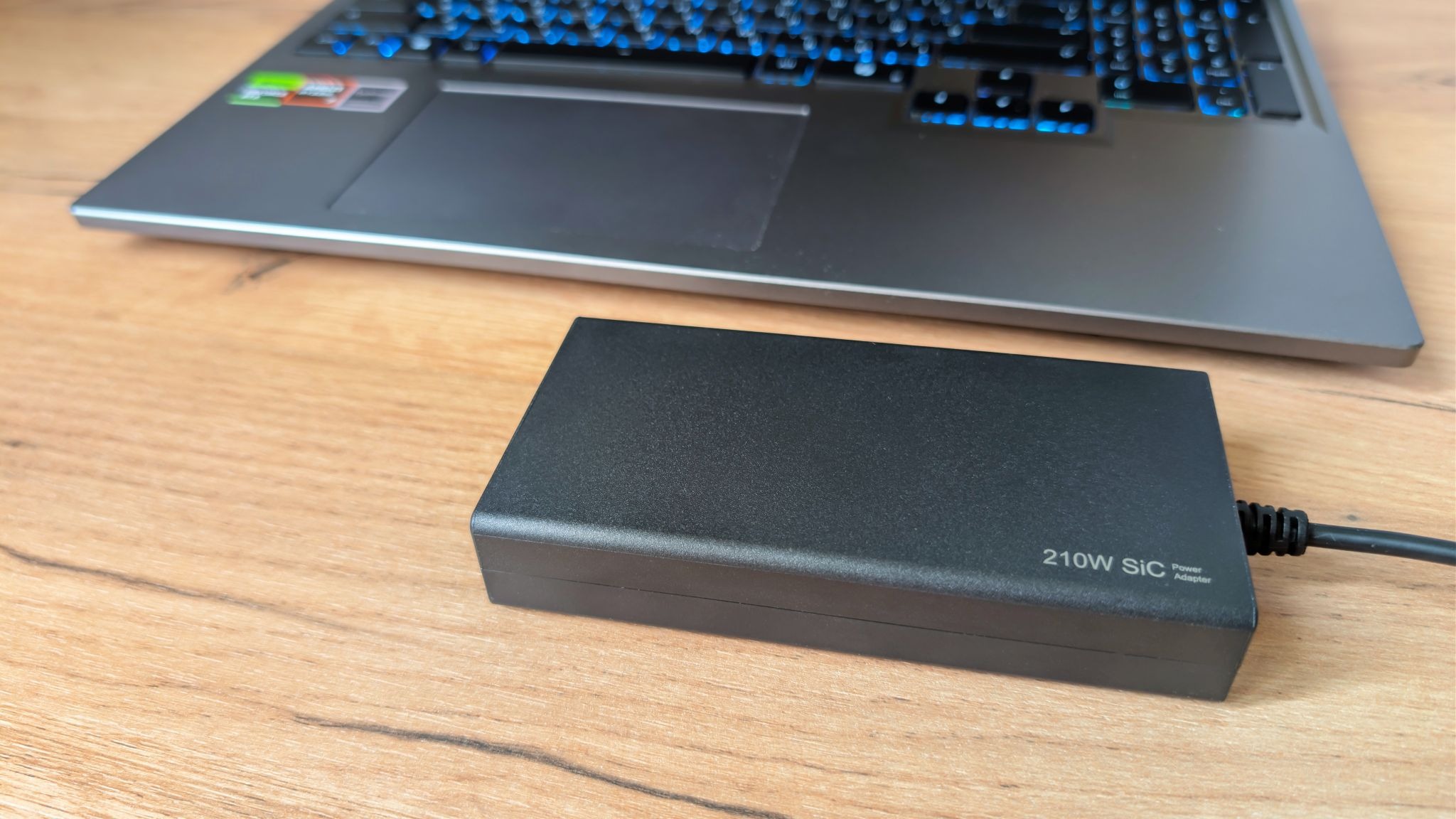
Battery life is provided by a 60 Wh cell – a typical figure for gaming notebooks. This capacity suffices for document work, video playback, or web surfing, but during gaming it is still advisable to plug in the supplied 210 W adapter; only then can the laptop unleash the full potential of the installed RTX 5060. Expecting a full workday on battery alone is unrealistic: under standard office load and video playback the notebook lasts about five hours.
the notebook lasts about five hours.
Briefly on the hidden aspects: the duo of 2 W speakers is not very loud, yet sound quality is above average – low‑end depth is lacking, but the mid‑ and high‑range are decent. Network connection stays stable with a decent router, and the built‑in Wi‑Fi 6 adapter performs at flagship‑level, without drops.
Характеристики и синтетика
The main attraction of the MAIBENBEN X16C lies in its excellent price‑to‑spec ratio. Essentially, for the money usually asked for laptops with previous‑generation graphics cards you receive a more up‑to‑date machine equipped with an RTX 50 series GPU, whose life cycle has only just begun. The test configuration looks like this:
Процессор: AMD Ryzen 7 H 255 (8 ядер/16 потоков, до 4,9 ГГц);
Видеокарта: GeForce RTX 5060 Laptop (8 ГБ GDDR7, TDP 115 Вт);
Оперативная память: один брус 16 ГБ DDR5‑5600 Essencore KD5AGSA80-56G4600 (максимум 32 ГБ);
Накопитель: NVMe PCIe 4.0 YMTC PC411-512GB‑B 512 ГБ.
The only point worth criticising is the modest storage capacity. Given the appetites of modern titles, you can comfortably keep a couple of online games and one or two single‑player projects at once. Fortunately, there is room to add extra drives (as well as a second RAM stick).
Such a configuration was likely chosen to keep the base price low. How critical is this for the end user? Judging by the synthetic 3DMark benchmark, even in stock form the MAIBENBEN X16C delivers more than respectable results.
The cooling system, typical for gaming notebooks, stays fairly quiet even in turbo mode, activated by a key above the keyboard. Efficiency remains solid – the GPU holds around 70 °C during stress tests. Headroom for substantial overclocking or voltage increase is probably limited, and any attempt in that direction would likely come at the cost of increased noise.
Тесты в играх
We start testing with a modern benchmark – Cyberpunk 2077. Running at native 1920×1200 resolution with the «Ray Tracing: Ultra» preset and DLSS set to «Quality» yields around 40 fps. Switching the preset to «Ray Tracing: Minimum» pushes performance to roughly 70‑75 fps. Adding frame generation (to fully exploit the RTX 50 advantages) breaks the 100 fps barrier in RT Ultra with 2× frame multiplication.
Next up is Pragmata at native resolution, preset «Quality» with ray tracing and path tracing, no frame generation, DLSS in «Balanced» mode – we see about 50 fps. Enabling frame generation raises the figure to 80‑90 fps depending on the scene. If you forego path tracing, smooth gameplay is achievable at roughly 100 fps.
Crimson Desert at native resolution, «Ultra» preset without scaling, delivers a solid 55‑60 fps – already comfortable for play. Activating DLSS lifts the rate to 70‑80 fps, making the action exceptionally fluid even in a demanding title. In the «Cinematic» mode with DLSS «Quality» you can expect 60‑65 fps.
Resident Evil Requiem (native resolution, path tracing, DLSS «Quality» with 2× frame generation) gives about 100 fps. If you turn off frame generation (for those who dislike the tech), the count drops to 60‑65 fps.
Итог
After hands‑on time with the MAIBENBEN X16C, the impression is of a well‑balanced machine. It does not try to out‑compete the priciest gaming laptops nor does it promise the impossible. Instead, it offers exactly the set of capabilities one expects from a contemporary gaming solution: a potent hardware platform, a good display, a comfortable keyboard, a sufficient assortment of ports, and room for future upgrades.
This approach makes the X16C an attractive option for users seeking a versatile notebook. During the day it handles office tasks effortlessly; in the evening it provides several hours of enjoyable play in the newest releases; and when needed it stays sufficiently portable to accompany its owner daily. Build quality, performance, and upgrade potential rank among the best, if not the best, in its price category.
Реклама. ГК МББ ТЕХНОЛОДЖИ КО., ЛИМИТЕД, ИНН 9909699946, erid: F7NfYUJCUneVcxY51swL